Definition
In the DSM-5-TR, the anxiety disorders are: separation anxiety disorder, selective mutism, specific phobia, social anxiety disorder, panic disorder, agoraphobia, generalized anxiety disorder, and those that are substance/medication-induced or due to another medical condition. OCD and PTSD are no longer in this group: since the DSM-5 they have chapters of their own.
Core idea: the 3 drawers of the DSM-5-TR
Anxiety disorders are the most prevalent group in mental health (lifetime prevalence close to 30%). The DSM-5-TR (2022) groups them into THREE clinical blocks, with an important change from the DSM-IV: anxiety, OCD, and trauma share mechanisms and symptoms, but the DSM separates them to make differential diagnosis easier.
If you learn this, the hard part of the Psychopathology exam is not the mix-up: it is knowing which drawer you should open first.
(American Psychiatric Association, DSM-5-TR, 2022. Synthesis of APA sources + secondary reviews verifiable on PubMed/PMC.)1. Where the DSM-5 classification comes from
The DSM is the diagnostic manual of the American Psychiatric Association (APA). Its history is the history of medicine:
| Edition | Year | Major change |
|---|---|---|
| DSM-I | 1952 | Theoretical, psychoanalytic classification. Low reliability. |
| DSM-III | 1980 | Revolution: adopts the Feighner criteria and the RDC (Research Diagnostic Criteria). Observable operational criteria. |
| DSM-IV | 1994 | DSM-IV-TR (2000) introduces the multiaxial model. GAD as a young category. |
| DSM-5 | 2013 | Drops the multiaxial system. Reorganizes. OCD leaves the anxiety disorders and forms its own block. |
| DSM-5-TR | 2022 | Text revision. Integrates "difficult to control" into criterion A of GAD. Other minor adjustments. |
If you want to see how anxiety is measured in practice, try the GAD-7 anxiety test, the most widely used screening questionnaire in the world, with its student mode.
2. Block 1 - Anxiety Disorders (7 disorders)
According to the DSM-5-TR, the "anxiety disorders" block includes seven specific disorders plus selective mutism. What they share: pathological fear or anxiety that is not transient and impairs functioning. Mnemonic:
Mnemonic: "G-PASS-SS +M"
GAD - Panic - Agoraphobia - Social - Specific phobia - Separation (+ Mutism, selective)
GAD · Generalized Anxiety Disorder (300.02 / F41.1)
The most studied category in the block. DSM-5-TR criteria, summarized:
- (A) Excessive anxiety and worry about a variety of activities or events, occurring on most days for at least 6 months.
- (B) Difficulty controlling the worry (built into A in the DSM-5-TR).
- (C) At least 3 of 6 associated symptoms (1 in children): restlessness · fatigability · difficulty concentrating · irritability · muscle tension · sleep disturbance.
- (D) Clinically significant distress or functional impairment.
- (E) Not attributable to a substance or medical condition, and does not occur exclusively during another disorder.
3. Block 2 - OCD and Obsessive-Compulsive and Related Disorders
They used to live under "anxiety." The DSM-5 takes them out to recognize their own mechanics: obsessions (intrusive, ego-dystonic thoughts) + compulsions (repeated acts to neutralize the anxiety). Mnemonic:
Mnemonic: "OCD-THBE"
OCD · Trichotillomania · Hoarding · Body (dysmorphic) · Excoriation (skin-picking)
Core features of OCD (APA, DSM-5-TR, 2022; OC Foundation)
- Obsessions: persistent, intrusive thoughts, images, or urges that cause anxiety, disgust, or significant distress. They are ego-dystonic (contrary to the patient's self, who recognizes them as their own and unwanted).
- Compulsions: repetitive behaviors (washing, checking, counting, reassurance seeking, avoiding situations) performed to neutralize the obsession. They take at least 1 hour per day and interfere with functioning.
- The patient recognizes that the compulsions are irrational (a feature of OCD, not of obsessive-compulsive personality disorder, which is a different category).
4. Block 3 - Trauma- and Stressor-Related Disorders
They used to live mixed in with anxiety. The DSM-5 separates them because their core mechanism is re-experiencing after the event, not anticipation (anxiety) or ritual intrusion (OCD). Mnemonic:
Mnemonic: "PAD"
PTSD · Acute stress · Adjustment (disorders)
PTSD · Post-Traumatic Stress Disorder (309.81 / F43.10)
Criteria summarized from the DSM-5-TR:
- (A) Exposure: direct experience, witnessing, or close knowledge of a traumatic event (death, threat, serious injury).
- (B) Intrusions: recurrent involuntary memories, distressing dreams, dissociative flashbacks.
- (C) Avoidance: efforts to avoid memories, thoughts, people, or activities related to the event.
- (D) Negative cognitions/affect: dissociative amnesia, negative beliefs about oneself/others/the world, guilt, fear, anhedonia, emotional detachment.
- (E) Hyperarousal: irritability, aggressive behavior, hypervigilance, sleep problems, concentration problems.
- (F) Duration > 1 month after the event.
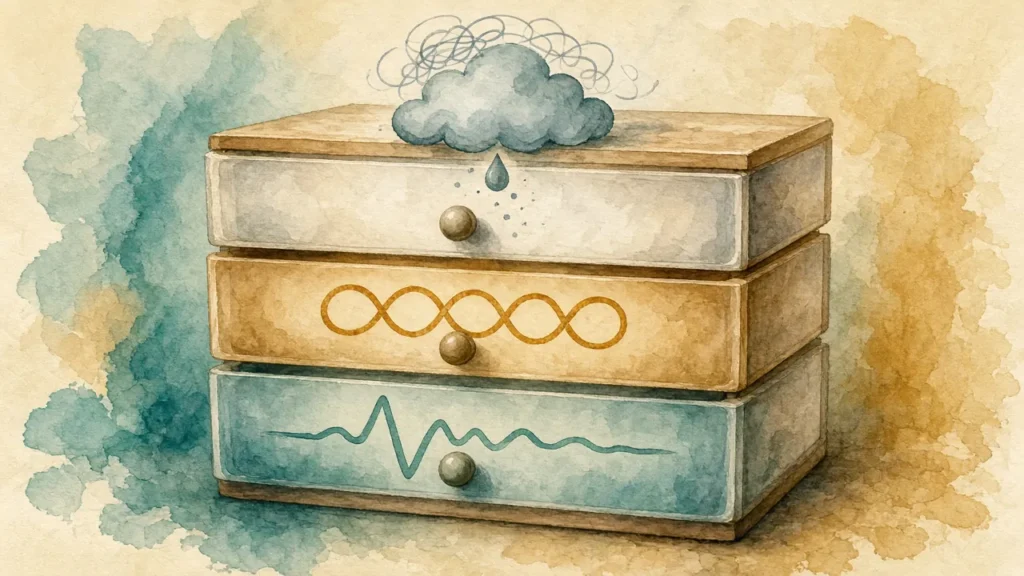
5. Everyday analogy - the 3-drawer DSM cabinet
Drawer 1 - "Anxiety": the folders of anticipatory fear. GAD (constant worry), Panic (the electric attacks that come all at once), Agoraphobia (fear of being trapped), Social (fear of being evaluated by others), Specific (the picky phobia: spiders, heights, blood), Selective mutism (children who talk at home but fall silent at school), Separation (distress when the caregiver is not there). All of them live in the future.
Drawer 2 - "OCD": the folders of the obsessive-compulsive loop. OCD (washing because of perceived contamination, checking the lock 40 times), Trichotillomania (pulling out hair), Hoarding (not throwing anything away), Body dysmorphia (seeing yourself as horrible even though everyone says you're not), Excoriation (scratching at the skin). All of them live in a loop with no exit.
Drawer 3 - "Trauma": the folders of the event that came back from the past. PTSD (flashbacks, avoidance, hyperarousal), Acute stress (same picture but between 3 days and 1 month), Adjustment (when a life change overwhelms us). All of them live in the past.
When you get a case on the exam, the right question is: which drawer do I pull this from. The drawer tells you the picture.
6. Exam traps - where students get mixed up the most
The difference is NOT that worry exists (we all worry). It is that it meets 3 simultaneous conditions: duration >= 6 months + 3 of 6 somatic symptoms (1 in children) + real functional impairment. Intense worry that is limited in time is not GAD. Chronic but mild worry is not GAD. You need all three together.
The two pictures have the same symptoms (intrusions, avoidance, hyperarousal). The boundary is temporal: acute stress lasts between 3 days and 1 month after the event. PTSD lasts more than 1 month. If you get a case where the person "still" has symptoms at 2 months, it is PTSD, not acute. Confusing them is one of the most typical exam mistakes.
They share the same word ("obsessive") and are easily confused. OCD = obsessions (intrusive, involuntary, ego-dystonic thoughts) + compulsions (repeated acts to neutralize). Obsessive-compulsive personality disorder (Axis II, Cluster C) = rigid perfectionism and preoccupation with rules, order, and control - WITHOUT real obsessions or compulsions. A person with OCD knows their rituals are irrational; a person with obsessive-compulsive personality disorder believes they are right. They belong to different blocks of the DSM.
Before (DSM-IV), panic with agoraphobia was a single category. In the DSM-5, panic and agoraphobia are independent disorders. A person can have panic WITHOUT agoraphobia (unexpected attacks but still goes out); or agoraphobia WITHOUT panic (fear of being trapped even though they have never had an attack).
7. For the exam - what they ask and how to answer
- What is the main novelty of the DSM-5 compared with the DSM-IV? OCD leaves the "anxiety disorders" block and forms its own group. PTSD moves from the anxiety block to the new "trauma and stressor" block.
- How many disorders are in the "Anxiety" block? Seven main ones (GAD, panic, agoraphobia, social, specific phobia, selective mutism, separation) plus selective mutism as an eighth in some classifications.
- What are the A criteria for GAD? Excessive worry + 6 months + hard to control + 3 symptoms (1 in children).
- How do you tell OCD apart from Obsessive-Compulsive Personality Disorder? OCD: true obsessions and compulsions, ego-dystonic. Personality disorder: rigid perfectionism without real obsessions, ego-syntonic.
- What is the time boundary between acute stress and PTSD? Acute stress: 3 days - 1 month. PTSD: more than 1 month.
- Why did the DSM-5 separate OCD from the anxiety disorders? Because the mechanism is different: OCD has obs. + comp. (neutralizing loop); anxiety is anticipation; trauma is re-experiencing after the event. Different mechanics => different blocks.
- What is the lifetime prevalence of GAD? 4-7% (APA, DSM-5-TR, 2022; Kessler et al., 2005 in Arch Gen Psychiatry).
- DSM-5-TR (2022) takes OCD out of the anxiety block and creates its own group. Trauma also has its own block.
- Anxiety block = G-PASS-SS +M = GAD, Panic, Agoraphobia, Social, Specific, Separation + Mutism.
- GAD = 6 months + 3 symptoms (1 in children) + functional impairment.
- OCD block = OCD-THBE = OCD, Trichotillomania, Hoarding, Body dysmorphia, Excoriation.
- Trauma block = PAD = PTSD (> 1 month) + Acute Stress (3 days-1 month) + Adjustment disorders.
- Traps: OCD != Obsessive-compulsive personality disorder; Panic != Agoraphobia; acute stress != PTSD; GAD != normal worry.
9. Self-test - 5 exam questions
Cover the answers and think. The idea is to explain the topic to yourself, as if you were explaining it to a classmate the day before the exam.