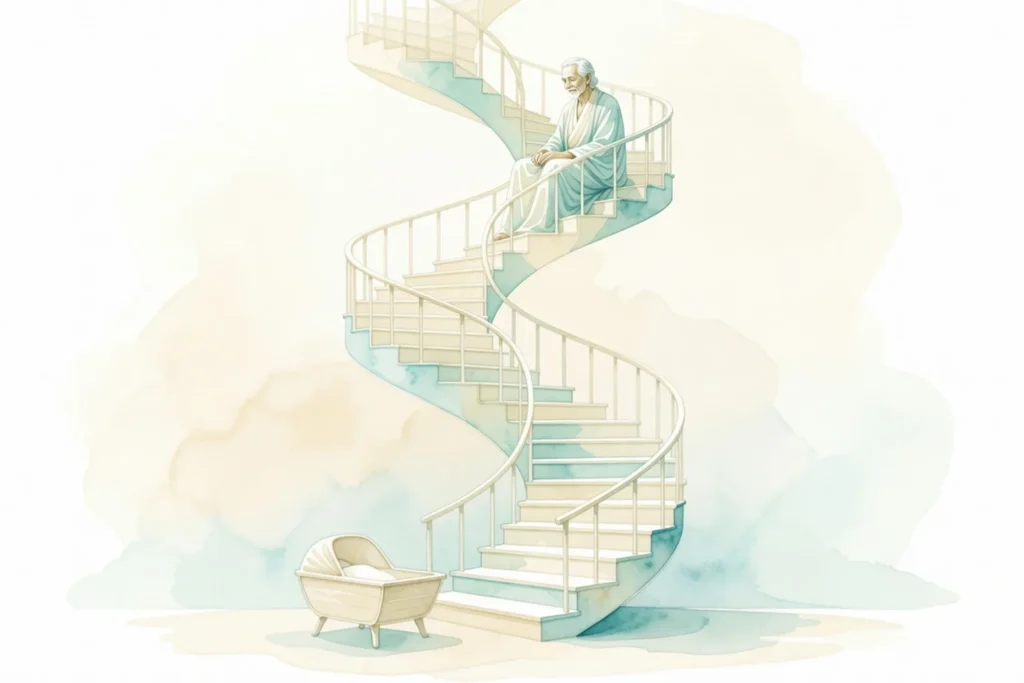
Definition
Erikson's stages of psychosocial development are eight phases of the life cycle, described by psychoanalyst Erik Erikson, in each of which a person faces a central tension between two opposing outcomes: trust versus mistrust in infancy, identity versus role confusion in adolescence, integrity versus despair in old age. Working through each tension builds a psychological strength, which Erikson called a virtue, that the person carries into later stages.
Picture three people on one ordinary Tuesday. A two-year-old drops her spoon over the edge of the high chair for the fifth time, watching to see whether anyone will pick it up. A fifteen-year-old scrolls through his own profile, deleting and re-posting photos, trying on versions of himself. A seventy-year-old, newly retired, sorts through a box of old photographs and wonders whether the life they add up to was a good one. None of them would call it a crisis. Erik Erikson would say all three are doing the same kind of work: answering the question their stage of life puts to them.
That is the appeal of his theory. Most developmental theories stop somewhere in adolescence, or they track only thinking, as Piaget's stages of cognitive development do. Erikson followed the person from the crib to old age and asked what each period demands of them socially and emotionally.
This guide gives you the eight stages with ages, crises and virtues in one chart, a worked example for each, the research that supports (and complicates) the model, and the mistakes that most often cost points on exams. Where textbooks disagree, we say so.
The short version
- Erik Erikson (1902–1994) was a German-born American psychoanalyst who trained in Vienna with Anna Freud.
- He set out the eight-stage model in Childhood and Society (1950). Later books, especially Identity: Youth and Crisis (1968), developed the idea of identity.
- Each stage centers on a psychosocial crisis: a tension between two poles, such as trust and mistrust, that is expected to be worked through in a favorable direction, not eliminated.
- A favorable balance leaves behind a virtue (hope, will, purpose, competence, fidelity, love, care, wisdom).
- Stages are not locked doors. Earlier tensions return later in life, and the age ranges in charts are approximations.
- Unlike Freud, Erikson put the social world, not only the drives, at the center of development.
What "psychosocial" means
Erikson started from psychoanalysis but changed its emphasis. Freud's psychosexual stages (oral, anal, phallic, latency, genital) describe how the drives are organized. Erikson kept the idea of ordered stages and the importance of early life, but he described each stage in terms of a relationship with other people and with a culture: a caregiver who responds or does not, a teacher who notices effort or ignores it, a partner who commits or withdraws. Hence psycho (the individual's inner life) plus social (what the surroundings ask of that individual at that age).
The key word is crisis. In everyday English a crisis is an emergency. For Erikson it is closer to a turning point: a period of heightened vulnerability and heightened potential, when development can move in a more or less favorable direction (Erikson, 1968). Nobody "fails" a stage in the sense of flunking it. What matters is the balance between the two poles. Even in the first stage, Erikson described a favorable ratio of trust to mistrust, not the complete absence of mistrust, since some wariness is realistic.
Erikson also pushed the timeline past Freud's. For Freud, the main architecture of personality is largely in place by adolescence. For Erikson, adulthood and old age have their own developmental tasks.
The eight stages
The ages below follow the convention used in most U.S. introductory textbooks. Erikson himself named the periods (infancy, early childhood, play age, school age, adolescence, young adulthood, adulthood, old age) rather than fixing exact ages, and published charts differ by a year or two at the boundaries. Treat every range as approximate.
Stage 1: Trust vs. mistrust (birth to about 18 months)
A baby depends entirely on other people to survive. When care is reasonably consistent, with feeding, comfort and attention arriving more or less when needed, the baby develops basic trust: a felt sense that the world is a safe enough place and that needs will be met. When care is erratic, cold or unpredictable, mistrust grows.
This does not mean one slow response to a cry leaves a permanent mark. Erikson spoke in terms of proportion: the balance should tip toward trust, and it does not need to be perfect.
The virtue of this stage is hope: the durable belief that wishes can be fulfilled, even when the outcome is uncertain.
A baby who receives consistent responses learns not only that the world is safe: she learns that her signals matter, that crying communicates, that someone is there on the other side. That primordial trust will be the emotional foundation of every future relationship.
In everyday life: an adult who needs constant proof of loyalty from a partner may be dealing with a version of the old trust question, not necessarily because of what happened in infancy, but because that is the form the question takes for them.
Stage 2: Autonomy vs. shame and doubt (about 18 months to 3 years)
Toddlers discover they can do things themselves: walk, choose which shirt to wear, say "no." This new motor and verbal control gives a sense of agency. Caregivers who allow safe exploration and tolerate messy attempts foster autonomy. Caregivers who are overcontrolling, overprotective or harshly critical of mistakes foster shame and doubt.
The virtue is will: the ability to make choices and act on them with determination, within reasonable limits.
Common exam mistake: equating autonomy with total independence. A two-year-old is not meant to manage alone. Autonomy here is the feeling of "I can try," not "I need no one."
Stage 3: Initiative vs. guilt (about 3 to 5 years)
Preschoolers and kindergartners are engines of plans. They build block towers, run pretend games, give orders to stuffed animals and ask a hundred questions about how things work. That initiative needs room. When parents and teachers meet it with curiosity and patience, children gain confidence in their ability to start and lead. When it is punished or ridiculed, guilt appears: the sense that wanting to take initiative is itself wrong.
The virtue is purpose: the ability to set goals and pursue activities with direction.
Stage 4: Industry vs. inferiority (about 5 to 12 years)
Elementary school brings structured work. Children learn concrete skills (reading, writing, arithmetic, working in a group) and need to feel competent at them. With real mastery and recognition for effort, they build industry, a sense of being able to produce things and do them well. Repeated failure or constant comparison with classmates breeds inferiority.
The virtue is competence: confidence in one's own skills to produce and contribute.
The competence built here is the ground the teenager stands on when asking the next question: who am I?
Stage 5: Identity vs. role confusion (about 12 to 18 years)
Adolescence is the most cited stage of the theory, and rightly so. The question is: Who am I? What do I want to do with my life? Where do I belong? Identity, as Erikson used the term, is an inner sense of sameness and continuity over time, matched by the way others recognize you. It means integrating the roles one has played (son or daughter, student, friend, teammate, partner) into a coherent self and projecting that self into the future: work, values, beliefs (Erikson, 1968).
When the pieces come together, identity forms. When they do not, role confusion follows: chronic uncertainty about who one is, borrowed identities, or absorption into groups that dictate every detail of behavior.
The virtue is fidelity: the ability to stay loyal to values and commitments one has freely chosen.
James Marcia turned this stage into something researchers could measure. In an interview study of college men, he distinguished four identity statuses based on whether a person has explored alternatives and whether they have made commitments: identity achievement (explored, committed), moratorium (exploring, not yet committed), foreclosure (committed without exploring, often by adopting what parents or peers handed over) and diffusion (neither exploring nor committed) (Marcia, 1966). Erikson's claim that identity comes before intimacy has some support: in a study of 88 college students, more advanced identity development went with higher levels of intimacy, and occupational identity was the strongest predictor (Kacerguis & Adams, 1980).
The timing is looser than the chart suggests. A meta-analysis of 124 studies found that large proportions of samples had not reached identity achievement by young adulthood (Kroger et al., 2010), and Arnett (2000) argued that the late teens through the twenties form a distinct period, "emerging adulthood," in which identity exploration is still going on.
Stage 6: Intimacy vs. isolation (about 18 to 40 years)
Young adulthood sets a new task: committing to a close relationship without losing oneself. This is not limited to romance. It includes deep friendship, close working partnerships and parenthood.
Real intimacy depends on a reasonably secure identity: it is easier to open up to someone when you are not afraid of dissolving in them. Without that footing, the person may drift toward isolation: avoiding commitment, keeping relationships shallow, or sliding into dependence in which the self disappears.
The virtue is love: mutual care and devotion between people.
In everyday life: the friend who says "I can't stand being alone, but I can't stand being with anyone either" is describing, in plain words, the pull between the fear of being swallowed and the fear of being left.
Stage 7: Generativity vs. stagnation (about 40 to 65 years)
Middle adulthood calls for generativity: concern for establishing and guiding the next generation. That can run through parenting, teaching, mentoring at work, creative output or community service. Psychologists later built models and measures of generativity from Erikson's idea (McAdams & de St. Aubin, 1992).
When energy flows into things that outlast one's own comfort, the result is a sense of usefulness and care. When it does not, stagnation can set in: a feeling of going nowhere, of self-absorption and of unused possibilities.
The virtue is care: commitment to the well-being of those who come after.
Research on older adults links this stage to the next. In a sample of 617 adults aged 60 to 86 from Germany, the Czech Republic and Cameroon, generativity was associated with greater ego integrity, which in turn was associated with less fear of death (Busch et al., 2018). Note what this does and does not show: it is a cross-sectional survey of people already in late life, not a study that followed people from midlife.
Stage 8: Ego integrity vs. despair (65 and older)
The last stage asks for a review of one's life and, ideally, acceptance of it. Ego integrity is a settled acceptance of the one life one had, achievements and failures included. Despair is the bitterness of recognizing that time is running out and that there is no second try.
The virtue is wisdom: an informed, calm acceptance of life's limits.
Ego integrity is not nostalgia or passive resignation. It is the ability to look at one's own path, with its achievements and its wounds, and recognize that it made sense, that it was a life lived, not a life wasted.
Studies of reminiscence, structured recall of meaningful life events, offer some evidence for this stage. In a quasi-experimental study of 90 Portuguese people aged 65 and over with depressive symptoms, only the reminiscence group improved significantly in overall psychological well-being and ego integrity (Afonso et al., 2011). A small study of 19 people with mild dementia found that reminiscence therapy improved quality of life, ego integrity and social behavior, though not depression or daily living activities (Jo & Song, 2015). Both are small, so treat them as supportive rather than conclusive.
After Erik Erikson's death in 1994, his wife and collaborator Joan Erikson added a ninth stage, about very old age, in an extended edition of The Life Cycle Completed (Erikson & Erikson, 1997). It is not part of the classic eight-stage model your course most likely tests.
Erikson's stages at a glance
| Stage | Approximate age | Crisis | Virtue |
|---|---|---|---|
| 1 | Birth to ~18 months | Trust vs. mistrust | Hope |
| 2 | ~18 months to 3 years | Autonomy vs. shame and doubt | Will |
| 3 | 3 to 5 years | Initiative vs. guilt | Purpose |
| 4 | 5 to 12 years | Industry vs. inferiority | Competence |
| 5 | 12 to 18 years | Identity vs. role confusion | Fidelity |
| 6 | 18 to 40 years | Intimacy vs. isolation | Love |
| 7 | 40 to 65 years | Generativity vs. stagnation | Care |
| 8 | 65 years and older | Ego integrity vs. despair | Wisdom |
The "virtues" are Erikson's later addition to the scheme; he developed them in his 1964 lectures Insight and Responsibility. If your instructor's chart gives slightly different ages, use theirs on their exam.
The epigenetic principle: how the stages connect
Erikson borrowed the epigenetic principle from embryology: anything that grows has a ground plan, and out of that plan the parts arise, each with its own time of special importance (Erikson, 1959). Applied to personality, this means every issue is present in some form from the start, but each has its decisive period, and each later stage builds on what came before.
The practical consequence is that no stage is settled once and for all. Someone who built a solid base of trust in childhood can find it shaken by betrayal in adulthood. The old question comes back, now with an adult's resources for working it through.
Longitudinal data fit that picture better than a strict staircase. In a 34-year study that followed two cohorts of college alumni to ages 43 and 54, the early issues (trust, autonomy, initiative) kept improving slowly through middle adulthood, as did generativity, and people who started adulthood at a disadvantage tended to catch up (Whitbourne et al., 2009).
Common mistakes that cost points on exams
- Saying each crisis is resolved once and for all. Erikson stressed that earlier issues can reopen. A resolution is a tendency, not a guarantee.
- Confusing "crisis" with "trauma." In Erikson's usage a crisis is a normal turning point, not a disaster.
- Memorizing the crises but forgetting the virtues. Many exams ask for both: hope, will, purpose, competence, fidelity, love, care, wisdom.
- Mixing up the ages. Stage 4 (industry) is the school years; stage 5 (identity) is adolescence. Swapping them is a classic multiple-choice error.
- Calling the theory "psychosexual." That is Freud's term. Erikson's is psychosocial: the stages are driven by relationships and cultural demands, not by erogenous zones.
- Treating the model as rigid. The ages are approximate markers, and a person can be working on more than one issue at a time.
- Treating the ninth stage as Erik Erikson's own. It was added by Joan Erikson after his death.
A student's question
If the stages are universal, why does everyone experience them so differently?
Because the "social" in psychosocial is doing real work. Each culture arranges childhood, schooling, work and old age differently. In a community where elders are consulted and respected, the last stage is easier to resolve; where older people are pushed to the margins, despair becomes more likely. Erikson proposed that the sequence of issues is universal, but how they are expressed depends on the setting. He took that seriously enough to study children among the Sioux in South Dakota and the Yurok of northern California, and he wrote about both in Childhood and Society (Erikson, 1950).
Strengths and limits of the theory
The model's lasting contribution is its sweep: a developmental account that covers the whole lifespan, treats adulthood as a time of change and puts culture inside development instead of outside it. It also gave researchers workable concepts. Marcia's identity statuses and measures of generativity both grew out of Erikson's ideas.
Its limits are equally worth knowing. Erikson built the theory from clinical work, case studies and cultural observation, so many of its claims were hard to test as stated. Critics have pointed out that its examples and ages reflect mostly European and North American samples, that the order and timing of the stages are looser in real lives than the chart implies, and that it says little about how a crisis gets resolved. Evidence from identity research (Kroger et al., 2010) and from long-term studies (Whitbourne et al., 2009) supports some parts of the model and complicates others.
How Erikson compares with other developmental theories
Erikson vs. Freud: from drives to relationships
Freud described stages organized around bodily zones and the drives. Erikson kept the idea of sequence and the importance of early experience, but he described what each period asks of a person in relation to others, and he extended the timeline across the whole life. Where Freud saw an instinctual energy seeking discharge, Erikson saw a person meeting the demands and opportunities of a culture.
Erikson vs. Piaget: emotion and social life vs. thinking
Piaget traced how thinking changes: sensorimotor, preoperational, concrete operational and formal operational stages. Erikson did not set out to explain cognition. The two accounts can be read side by side. A child in the industry stage (roughly 5 to 12) is also, in Piaget's terms, usually in concrete operations, and both frameworks mark the school years as a shift toward systematic work. For the full cognitive account, see our guide to Piaget's four stages of cognitive development.
Erikson vs. Vygotsky: culture as the setting for development
Vygotsky argued that learning and thinking are shaped by social interaction and cultural tools. Erikson reached for culture from a different direction, through the crises that a culture makes easier or harder. Both reject the picture of development as something that happens inside an isolated individual.
Where the theory is used
In counseling and psychotherapy training, the model offers a map of the questions people tend to bring at different points in life. A thirty-five-year-old who fears commitment may be working through intimacy (stage 6); a fifty-year-old describing emptiness may be struggling with generativity (stage 7). The framework is a way to organize a case, not a substitute for assessment.
In education, preschool and kindergarten teachers can support initiative (stage 3) by letting children plan and carry out projects, such as building a fort from blocks, putting on a play or inventing a game. Elementary teachers can support industry (stage 4) by praising effort and process, giving specific feedback and setting up group work in which each child contributes a different skill.
In gerontology, life-review and reminiscence programs draw directly on stage 8. Guided autobiography, shared memory groups and structured life-review exercises aim to help older people integrate their life stories (see the studies above for the evidence and its limits).
In social work and career counseling, the model helps explain why some interventions suit certain ages better than others. A career-exploration workshop will usually do more for a high-school junior (stage 5) than for a third-grader (stage 4), because the career question belongs to the identity stage.
Frequently asked questions
Is Erikson's theory universal, or does it depend on culture?
Erikson proposed that the sequence of issues is universal: trust, autonomy, identity and the rest are tasks every person meets. How a given culture helps or hinders working through each issue varies a great deal, which is why he studied children in different cultural settings.
What happens if a stage is resolved unfavorably?
The person is not doomed. The issue can come up again later, and with support or a changed environment it can be worked through more favorably. The theory is epigenetic, not deterministic.
How does Erikson's theory differ from Freud's?
Freud's psychosexual stages center on bodily zones and the drives and end around adolescence. Erikson's psychosocial stages center on social relationships and developmental tasks, and they run through old age.
What is the difference between an identity crisis and role confusion?
In Erikson's formulation they are the two sides of one stage. The identity crisis is the active search ("Who am I?"). Role confusion is the unfavorable outcome of that search: the inability to settle on a coherent identity.
Can the stages be measured?
Yes, in part. Marcia's interview method classifies identity status (Marcia, 1966), and later researchers have built self-report measures of Eriksonian issues and of generativity (McAdams & de St. Aubin, 1992; Whitbourne et al., 2009).
Keep reading
- Piaget's 4 stages of cognitive development — how thinking changes from infancy to adolescence, the companion to Erikson's emotional and social account.
References
- Afonso, R. M., Bueno, B., Loureiro, M. J., & Pereira, H. (2011). Reminiscence, psychological well-being, and ego integrity in Portuguese elderly people. Educational Gerontology, 37(12), 1063–1080. https://doi.org/10.1080/03601277.2010.500585
- Arnett, J. J. (2000). Emerging adulthood: A theory of development from the late teens through the twenties. American Psychologist, 55(5), 469–480. https://doi.org/10.1037/0003-066X.55.5.469
- Busch, H., Hofer, J., Poláčková Šolcová, I., & Tavel, P. (2018). Generativity affects fear of death through ego integrity in German, Czech, and Cameroonian older adults. Archives of Gerontology and Geriatrics, 77, 89–95. https://doi.org/10.1016/j.archger.2018.04.001
- Erikson, E. H. (1950). Childhood and society. W. W. Norton.
- Erikson, E. H. (1959). Identity and the life cycle: Selected papers. International Universities Press.
- Erikson, E. H. (1964). Insight and responsibility: Lectures on the ethical implications of psychoanalytic insight. W. W. Norton.
- Erikson, E. H. (1968). Identity: Youth and crisis. W. W. Norton.
- Erikson, E. H., & Erikson, J. M. (1997). The life cycle completed (Extended version). W. W. Norton.
- Jo, H., & Song, E. (2015). The effect of reminiscence therapy on depression, quality of life, ego-integrity, social behavior function, and activities of daily living in elderly patients with mild dementia. Educational Gerontology, 41(1), 1–13. https://doi.org/10.1080/03601277.2014.899830
- Kacerguis, M. A., & Adams, G. R. (1980). Erikson stage resolution: The relationship between identity and intimacy. Journal of Youth and Adolescence, 9(2), 117–126. https://doi.org/10.1007/BF02087930
- Kroger, J., Martinussen, M., & Marcia, J. E. (2010). Identity status change during adolescence and young adulthood: A meta-analysis. Journal of Adolescence, 33(5), 683–698. https://doi.org/10.1016/j.adolescence.2009.11.002
- Marcia, J. E. (1966). Development and validation of ego-identity status. Journal of Personality and Social Psychology, 3(5), 551–558. https://doi.org/10.1037/h0023281
- McAdams, D. P., & de St. Aubin, E. (1992). A theory of generativity and its assessment through self-report, behavioral acts, and narrative themes in autobiography. Journal of Personality and Social Psychology, 62(6), 1003–1015. https://doi.org/10.1037/0022-3514.62.6.1003
- Whitbourne, S. K., Sneed, J. R., & Sayer, A. (2009). Psychosocial development from college through midlife: A 34-year sequential study. Developmental Psychology, 45(5), 1328–1340. https://doi.org/10.1037/a0016550