Definition
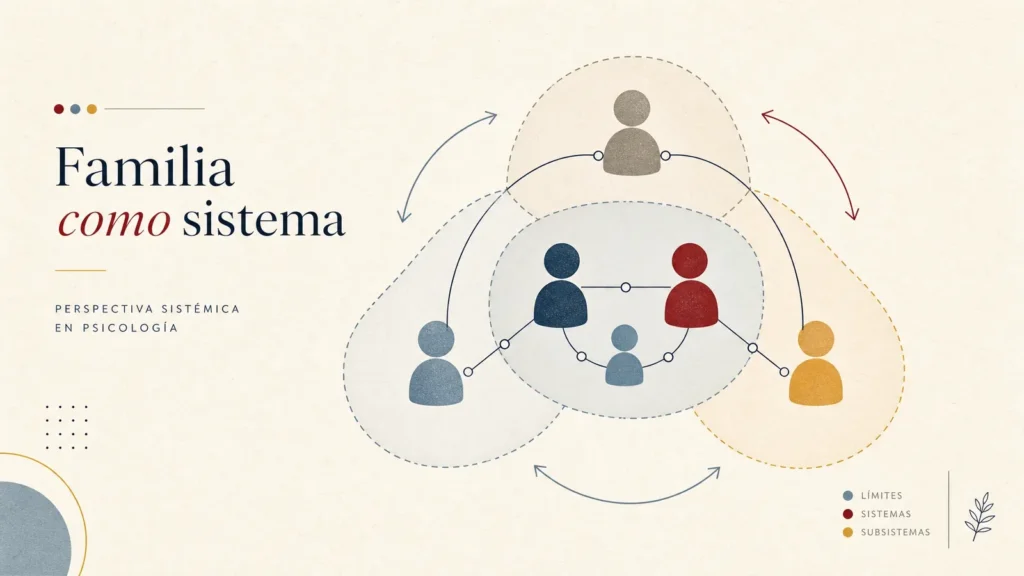
Family systems theory treats the family as an organized whole whose members are interdependent: each person's behavior affects, and is affected by, everyone else's. Problems are therefore read as patterns of interaction (repeated sequences, rules, boundaries and roles) and not only as traits of one individual.
A fifteen-year-old starts spending every evening behind a closed bedroom door. His father reads this as defiance and tightens the rules. His mother, hoping to keep the peace, asks the father to ease up. The father feels his authority slipping and gets stricter. The boy retreats further. If you look only at the teenager, you see withdrawal. If you look at the family, you see a loop in which everyone's reasonable-looking move feeds the next one.
That change of lens is the core of family systems theory, and it is why the topic shows up in courses on abnormal psychology, counseling, social work and marriage and family therapy. This guide gives you a definition you can write on an exam, the key concepts with examples, the contributions of Minuchin, Bowen and the Palo Alto group, what research says about systemic interventions, and the mistakes that most often cost points.
The short version
- A system is a set of interacting parts that form a whole; a family is an open system that exchanges information with its environment (school, work, culture, extended family).
- The unit of analysis is the pattern of relationships, not the isolated individual.
- Core concepts: circular causality, feedback, homeostasis, boundaries, subsystems, hierarchy, triangles and the family life cycle.
- A symptom can be read as part of a sequence that maintains, expresses or tries to change the family's balance. That is a statement about function, not about blame.
- Reviews of the evidence find that family and systemic interventions help with many child and adolescent problems (Carr, 2014).
Quick map for studying or presenting
| If you need… | Read first | What you take away |
|---|---|---|
| An exam answer | A short definition for exams | A definition and a model answer |
| An example for a presentation | A worked example | A circular sequence in one family |
| To tell concepts apart | Key concepts, one at a time | Circularity, feedback, homeostasis, boundaries, hierarchy |
| To connect the authors | How the main schools differ | Minuchin, Bowen and Watzlawick |
What it means to call a family a system
A family is not just "a group of people." The systemic idea is stronger: it is a relational organization in which what one person does changes the whole field. Seen alone, the teenager in the opening example is withdrawn; seen with his family, he is one move in a sequence. Instead of asking only "what is wrong with this person?", the systemic lens asks which relational pattern is organizing the problem.
A short definition for exams
If an exam asks for a definition, a solid answer could read:
From the systemic perspective, the family is an open, relational system. Its members cannot be understood in isolation, because each person's behavior affects, and is affected by, the behavior of the others. An individual symptom can therefore be read as part of a family's interactional pattern, not as a purely intrapsychic phenomenon.
Saying "system" does not erase the individual: the lens places a person's history, biology and resources in context.
Linear versus circular thinking
The most useful contrast for exams is between linear and circular explanations.
| Approach | Typical question | Example |
|---|---|---|
| Linear | What caused the problem? | "He acts out because he is oppositional." |
| Circular | What sequence keeps the problem going? | "His father's control increases his opposition, and his opposition increases his father's control." |
Linear thinking looks for a first cause and tends to locate it in one person. Circular thinking looks at loops, in which each person's behavior is both a response and a stimulus. The idea draws on von Bertalanffy's general systems theory (1968) and on cybernetics, in which systems regulate themselves through feedback. It changes the intervention: instead of trying to fix the "problem member," a systemic clinician works on the sequence, for instance by helping the father stop chasing, the mother stop mediating on reflex, and the family find another way to handle tension.
Key concepts, one at a time
Circularity
Circularity means that A influences B and B influences A. One member's silence can provoke insistence in another, and that insistence can deepen the silence.
Feedback
Feedback is the information a system uses to regulate itself. Negative (stabilizing) feedback reduces deviation and restores the usual pattern: a family that answers every disagreement with "let's not make a big deal of it" is using negative feedback to preserve stability. Positive (amplifying) feedback increases deviation and can push a system toward change, or toward escalation, as when a shouting match grows louder with each turn.
Homeostasis
Homeostasis is a system's tendency to maintain its organization. The classic (and often misread) idea is that a symptom can serve a stabilizing function. A child's school problems, for example, may draw two parents together in worry and keep them from facing a strain in their own relationship. This does not mean the child "wants" to be ill, or that the parents did anything wrong. It means the symptom is part of how the system is currently balanced.
Boundaries and subsystems
Salvador Minuchin (1974) described family structure in terms of subsystems (the parental or couple subsystem, the sibling subsystem, grandparent-parent ties) and the boundaries between them. Boundaries can be clear, rigid (members are isolated, or "disengaged") or diffuse (members are overinvolved, or "enmeshed"). A 13-year-old who becomes her mother's main confidante about the marriage illustrates a weakened generational boundary: she occupies a place that belongs to another adult. Enactments, in which the therapist has family members interact in the session so the pattern can be seen and changed, are a signature technique of this approach (Nichols & Fellenberg, 2000).
Hierarchy
Hierarchy is not authoritarianism. It means that the adults can care for, guide and set limits for the children. When the hierarchy inverts, you see parentification, cross-generational coalitions or children caught in adult conflict.
Triangles and differentiation of self
Murray Bowen (1978) argued that when anxiety between two people rises, a third person is often pulled in to stabilize things, forming a triangle. His concept of differentiation of self describes the ability to keep a distinct sense of self and think clearly while staying emotionally connected, rather than fusing with the family or cutting off from it.
Rules, roles and the family life cycle
Families run on rules (spoken and unspoken) and roles. Systems also change over time: the arrival of a baby, a child leaving home, a divorce, a death or a move forces the system to reorganize, which is why many referrals cluster around transitions.
A worked example: the symptom in context
Danny, ten, has severe tantrums every school morning. An individual-focused reading might consider anxiety, oppositional behavior or a learning problem, and all of those can matter. A systemic reading adds questions such as:
- What happens in the household the night before?
- Who steps in first when Danny cries?
- What do the parents do with each other during the episode?
- Does the tantrum bring the parents together or intensify their conflict?
- What changes at home when Danny ends up staying home?
Suppose that each morning his father insists on a routine, his mother overrides him to calm Danny, his father withdraws irritated, and Danny stays close to his mother. The sequence runs: symptom, family reaction, short-term relief, maintenance of the symptom. The intervention is not just telling Danny to control himself. It might involve a united parental plan, clear and predictable limits, emotional validation and a gradual return to school where appropriate.
How the main schools differ
Minuchin: structure, boundaries and subsystems
Salvador Minuchin made the architecture of the family visible. His question was not "who is sick?" but "how is this family organized?"
Bowen: differentiation and triangles
Murray Bowen focused on the emotional system: when anxiety rises between two members, a third is often drawn in.
Watzlawick: communication and interactional patterns
Watzlawick, Beavin and Jackson (1967) argued that communication does more than transfer information: it also defines the relationship. Their axiom that one cannot not communicate matters here, because even silence communicates. See Watzlawick's five axioms of communication.
| Approach | Key figure | Central idea | Typical focus |
|---|---|---|---|
| Structural | Salvador Minuchin | Family organization: boundaries, subsystems, hierarchy | Realigning structure, often through enactments |
| Bowen family systems | Murray Bowen | Emotional system: differentiation of self, triangles | Reducing reactivity and fusion across generations |
| Communication / Palo Alto | Gregory Bateson, Don Jackson, Paul Watzlawick and colleagues | Communication patterns, double binds, the axioms of communication | Interrupting problem-maintaining interaction sequences |
The Palo Alto group's best-known early paper proposed the "double bind" as a pattern of contradictory messages in families (Bateson et al., 1956). It is a historically important idea, but the original proposal that it explains schizophrenia has not held up and is now treated as a landmark in the history of the field, not as an established cause. For a closer look at structure, see our guide to Minuchin's boundaries, subsystems and hierarchies, and to map a family on paper, try the genogram maker.
What the research says
Systemic ideas are not only theory. Pinsof and Wynne (1995) reviewed the research on marital and family therapy and concluded that it was effective, and Shadish and Baldwin (2003) reached a similar conclusion in a meta-analysis of the field. Carr (2014) reviewed the evidence base for family therapy and systemic interventions in child-focused problems and found support for a range of approaches across several problem areas, while noting that the strength of evidence differs by problem and by method.
Two further strands matter for students. Walsh (2003) framed family resilience, arguing that families are not only a source of risk but also of meaning, support and reorganization after adversity. And the Biobehavioral Family Model links family relationships to health through stress-related psychobiological processes (Woods et al., 2014), which is one reason the systems view is more than a metaphor. In the Circumplex Model, Olson (2000) describes family functioning along dimensions of cohesion, flexibility and communication, which gives researchers a way to measure what clinicians observe.
Family systems theory versus family typology
Students often mix up two related topics. Family typology is descriptive: it names configurations such as nuclear, extended, single-parent, blended, enmeshed or disengaged. Family systems theory is explanatory: it asks how relationships are regulated, how information circulates and how a pattern is maintained or changed. Being able to list family types is not the same as thinking systemically.
How a systemic assessment starts
A systemic assessment begins by building a relational map, not by listing symptoms. Questions a student can practice include:
- Who lives with whom, and who actually takes part in decisions?
- What happens right before and right after the symptom?
- What solutions have the family already tried, and how did they turn out?
- Are there stable alliances of two members against a third?
- Are the boundaries between adults and children clear or blurred?
- Which topics are off limits in this family?
- What would change for the family if the problem improved?
That last question is uncomfortable but informative: improvement can redistribute power, force a family to face a loss or end a role someone has played for years.
The most serious error: turning systems thinking into blame
The worst mistake is saying "the family caused the symptom," which turns a search for patterns into an accusation. Other factors still count (Carr, 2014). Ask instead what pattern repeats, what function it serves and what small change could reorganize it.
Common mistakes that cost points on exams
- Saying the family "causes" the symptom. The systemic claim is about patterns that maintain a problem, not about blame. Individual, biological and social factors still count.
- Using "system" as a synonym for "group." A system has interdependence, organization and feedback; a group is just a set of people.
- Confusing homeostasis with "everything is fine." Homeostasis can preserve a painful pattern.
- Treating hierarchy as authoritarianism. In structural terms it means a functioning adult subsystem.
- Listing family types and calling it systems theory. Typology describes; systems theory explains.
- Treating circular causality as "everyone is equally responsible." Circular description does not erase differences in power or the fact that abuse and violence are the responsibility of the person who commits them.
- Forgetting that the individual still matters. The systemic lens places a person in context; it does not delete personal history, biology or choice.
A student's question
"If the symptom has a function in the family, doesn't that blame the parents?" No. Saying a behavior fits into a sequence is a description of how people respond to each other, usually with good intentions and incomplete information. A careful systemic formulation asks what pattern repeats, what role the symptom plays in it, and what small change could reorganize it. It also respects resources: families are often where recovery gets its support (Walsh, 2003).
Checklist for studying the family as a system
Before a midterm or presentation, check that you can answer:
- What separates an individual, a group and a system?
- What does circularity mean?
- What is family homeostasis?
- How do boundaries, subsystems and hierarchy work?
- Why can a symptom have a relational function?
- What did Minuchin, Bowen and Watzlawick contribute?
- How do you avoid blaming the family?
- Which clinical example would you use?
If you can answer all eight with one case, you have the core of the topic.
Frequently asked questions
What is family systems theory in psychology?
It is the view that a family is an interdependent network of relationships, so each member's behavior is both shaped by and shapes the others'. Psychological problems are understood within patterns of communication, roles, boundaries and rules.
Does systemic therapy blame the family?
It should not. A sound systemic approach looks for sequences that keep a problem going and for family strengths that can support change.
What is an example of a family as a system?
A teenager withdraws, the father increases control, the mother tries to mediate, the father becomes stricter and the teenager withdraws further. The problem is located in the loop, not only in the teenager.
What is the difference between family therapy and systemic therapy?
Family therapy usually means working with several family members together. Systemic therapy is a way of thinking that can be applied with an individual, a couple or a family, always reading the problem relationally and in context.
Which theorists should I know?
At minimum: von Bertalanffy (general systems theory), Bateson and the Palo Alto group (communication and the double bind), Minuchin (structure), and Bowen (differentiation and triangles).
Educational content for students. If a real family situation involves violence, abuse, or risk of self-harm, contact your local emergency number or a qualified professional; findahelpline.com lists services by country.
Keep reading
- Watzlawick's 5 axioms of communication — how communication patterns organize relationships.
- Von Bertalanffy's general systems theory in psychology — where the systems idea comes from.
- Minuchin's structural family therapy — boundaries, subsystems and hierarchies in depth.
- How to make a genogram, step by step — a standard tool for mapping a family system.
References
- Bateson, G., Jackson, D. D., Haley, J., & Weakland, J. (1956). Toward a theory of schizophrenia. Behavioral Science, 1(4), 251–264. https://doi.org/10.1002/bs.3830010402
- Bowen, M. (1978). Family therapy in clinical practice. Jason Aronson.
- Carr, A. (2014). The evidence base for family therapy and systemic interventions for child-focused problems. Journal of Family Therapy, 36(2), 107–157. https://doi.org/10.1111/1467-6427.12032
- Minuchin, S. (1974). Families and family therapy. Harvard University Press.
- Nichols, M. P., & Fellenberg, S. (2000). The effective use of enactments in family therapy: A discovery-oriented process study. Journal of Marital and Family Therapy, 26(2), 143–152. https://doi.org/10.1111/j.1752-0606.2000.tb00285.x
- Olson, D. H. (2000). Circumplex model of marital and family systems. Journal of Family Therapy, 22(2), 144–167. https://doi.org/10.1111/1467-6427.00144
- Pinsof, W. M., & Wynne, L. C. (1995). The efficacy of marital and family therapy: An empirical overview, conclusions, and recommendations. Journal of Marital and Family Therapy, 21(4), 585–613. https://doi.org/10.1111/j.1752-0606.1995.tb00179.x
- Shadish, W. R., & Baldwin, S. A. (2003). Meta-analysis of MFT interventions. Journal of Marital and Family Therapy, 29(4), 547–570. https://doi.org/10.1111/j.1752-0606.2003.tb01694.x
- von Bertalanffy, L. (1968). General system theory: Foundations, development, applications. George Braziller.
- Walsh, F. (2003). Family resilience: A framework for clinical practice. Family Process, 42(1), 1–18. https://doi.org/10.1111/j.1545-5300.2003.00001.x
- Watzlawick, P., Beavin, J. H., & Jackson, D. D. (1967). Pragmatics of human communication: A study of interactional patterns, pathologies, and paradoxes. W. W. Norton.
- Woods, S. B., Priest, J. B., & Roush, T. (2014). The Biobehavioral Family Model: Testing social support as an additional exogenous variable. Family Process, 53(4), 672–685. https://doi.org/10.1111/famp.12086